ST_Intersects
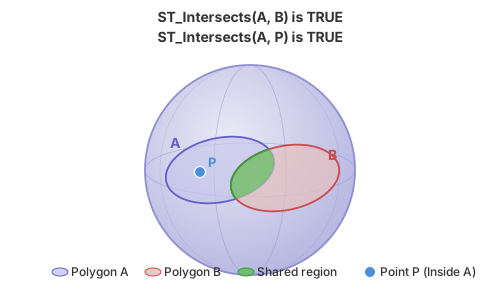
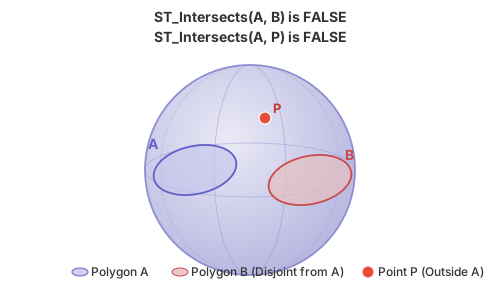
Introduction: Tests whether two geography objects intersect on the sphere using S2 spherical boolean operations. Returns true if A and B share any portion of space (including a single boundary point), and false if they are fully disjoint.
Edges are interpreted as great-circle arcs, so the test is correct even when geographies cross the antimeridian or wrap around the poles — situations where a planar ST_Intersects would be wrong.
Polygon ring roles follow the simple-features structure: the first ring is a shell and subsequent rings are holes, regardless of input winding. Sedona preserves the submitted coordinate order for structural output such as ST_AsText, while normalizing only the S2-facing traversal used by spherical operations.
Each Geography polygon shell is normalized to an area of at most one hemisphere. A shell intended to represent more than half the sphere is therefore interpreted as its complement; reversing the ring's coordinate sequence does not select the larger region.
Format:
ST_Intersects (A: Geography, B: Geography)
Return type: Boolean
Since: v1.9.1
SQL Example — overlapping polygons:
SELECT ST_Intersects(
  ST_GeogFromWKT('POLYGON ((0 0, 2 0, 2 2, 0 2, 0 0))', 4326),
  ST_GeogFromWKT('POLYGON ((1 1, 3 1, 3 3, 1 3, 1 1))', 4326)
);
Output:
true
SQL Example — disjoint polygons:
SELECT ST_Intersects(
  ST_GeogFromWKT('POLYGON ((0 0, 1 0, 1 1, 0 1, 0 0))', 4326),
  ST_GeogFromWKT('POLYGON ((10 10, 11 10, 11 11, 10 11, 10 10))', 4326)
);
Output:
false