ST_Buffer
Introduction: Returns a Geography whose interior is the metric ε-buffer of the input on the sphere. The distance argument is always interpreted as meters along the spheroid — there is no useSpheroid flag because Geography is inherently spheroidal.
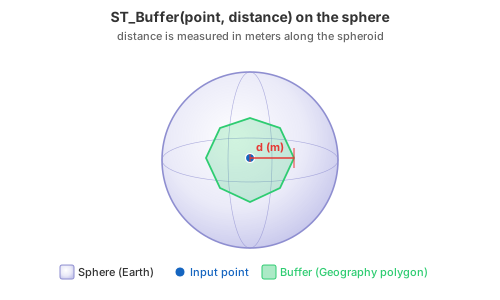
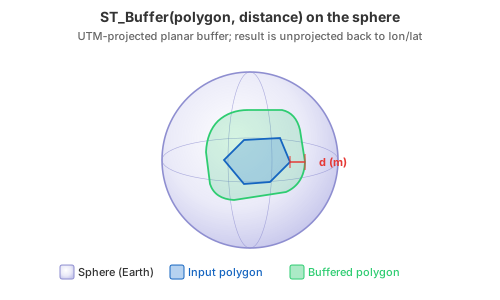
Internally, Sedona projects the input to the most appropriate UTM zone (selected via ST_BestSRID), applies a planar buffer in that zone, and projects the result back to lon/lat. This produces accurate results for inputs that fit inside a single UTM zone (~6° wide). For larger inputs the same accuracy caveats apply as for ST_Buffer on Geometry with useSpheroid = true.
Format:
ST_Buffer (geog: Geography, distanceMeters: Double)
ST_Buffer (geog: Geography, distanceMeters: Double, parameters: String)
Return type: Geography
Since: v1.9.1
useSpheroid is not accepted for Geography inputs
The 3-argument form ST_Buffer(geom, distance, useSpheroid: Boolean) from the Geometry
overload is rejected when the first argument is a Geography. Geography is inherently
spheroidal, so the flag would be either redundant (useSpheroid = true) or contradictory
(useSpheroid = false). A call like
SELECT ST_Buffer(ST_GeogFromWKT('POINT(0 0)', 4326), 1000.0, true); -- ❌ throws
raises:
IllegalArgumentException: ST_Buffer does not accept a useSpheroid argument for
Geography inputs (Geography is always spheroidal). Use ST_Buffer(geog, distance) or
ST_Buffer(geog, distance, parameters) instead.
Drop the useSpheroid argument, or — if you really want a planar buffer — convert to
Geometry first via ST_GeogToGeometry and use the Geometry overload of ST_Buffer.
The optional parameters string accepts the same JTS-style key/value pairs used by ST_Buffer for Geometry:
| Key | Default | Allowed values |
|---|---|---|
quad_segs |
8 |
positive integer — segments per quadrant in curved corners |
endcap |
round |
round, flat, butt, square |
join |
round |
round, mitre (or miter), bevel |
mitre_limit (or miter_limit) |
5.0 |
positive decimal |
side |
both |
both, left, right (single-sided buffer for linestrings) |
Notes:
- A negative
distanceMetersshrinks polygons (returning a smaller polygon, possiblyEMPTYwhen the radius exceeds the polygon's narrowest dimension); for points and lines a negative buffer always produces an empty result. - The output
Geographypreserves the input's SRID. If the input has no SRID set, the result is normalised to WGS84 (EPSG:4326).
SQL Example
-- 1 km buffer around a point
SELECT ST_AsText(ST_Buffer(ST_GeogFromWKT('POINT(0 0)', 4326), 1000));

-- 200 m buffer around a polygon, with low-fidelity corners
SELECT ST_AsText(ST_Buffer(
  ST_GeogFromWKT('POLYGON((0 0, 0.01 0, 0.01 0.01, 0 0.01, 0 0))', 4326),
  200,
  'quad_segs=4 endcap=square'
));

-- Use the buffer as a containment test
SELECT ST_Contains(
  ST_Buffer(ST_GeogFromWKT('POINT(0 0)', 4326), 1000),
  ST_GeogFromWKT('POINT(0.005 0.005)', 4326)
);