RS_Stack
Introduction: Returns a combined multi-band raster from 2 or more input Rasters, stacking their bands. The order of bands in the resultant raster will be in the order of the input rasters. For example if RS_Stack is called on two 2-banded raster, raster1 and raster2, the first 2 bands of the resultant 4-banded raster will be from raster1 and the last 2 from raster 2.
Note
If the provided input Rasters don't have same shape an IllegalArgumentException will be thrown.
Note
This function was named RS_Union before v2.0.0. It was renamed because it stacks bands rather than merging grids the way a raster union does; RS_Union no longer exists.
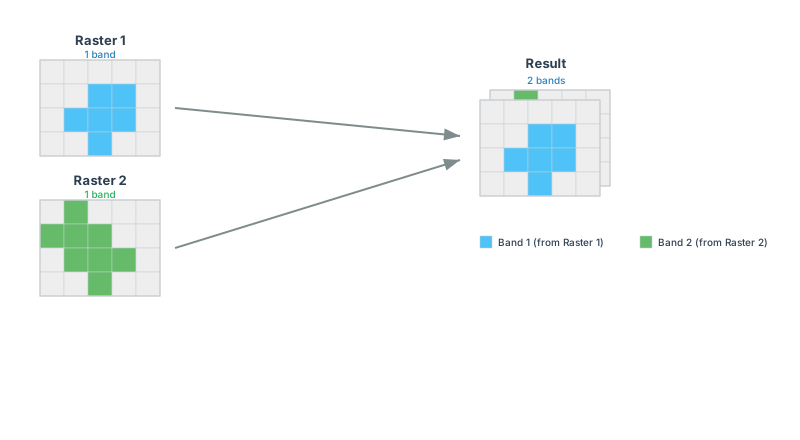
Format:
RS_Stack (raster1: Raster, raster2: Raster)
RS_Stack (raster1: Raster, raster2: Raster, raster3: Raster)
RS_Stack (raster1: Raster, raster2: Raster, raster3: Raster, raster4: Raster)
RS_Stack (raster1: Raster, raster2: Raster, raster3: Raster, raster4: Raster, raster5: Raster)
RS_Stack (raster1: Raster, raster2: Raster, raster3: Raster, raster4: Raster, raster5: Raster, raster6: Raster)
RS_Stack (raster1: Raster, raster2: Raster, raster3: Raster, raster4: Raster, raster5: Raster, raster6: Raster, raster7: Raster)
Return type: Raster
Since: v2.0.0 (as RS_Union since v1.6.0)
SQL Example
SELECT RS_Stack(raster1, raster2, raster3, raster4) FROM rasters
Output:
GridCoverage2D["g...