ST_Area
Introduction: Returns the spherical area of a geography in square meters, calculated on the sphere. The Earth is modeled as a sphere of radius R = 6 371 008 m (the mean Earth radius); the result is the area of the polygon's interior on that sphere. Returns 0.0 for non-areal geographies (points, linestrings) and for NULL.
Multi-polygons sum the children's areas; geography collections recurse into their members.
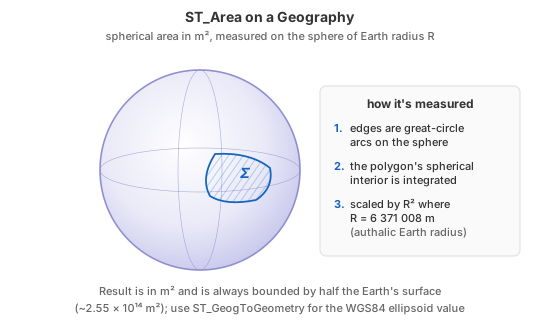
Each Geography polygon shell is normalized to an area of at most one hemisphere. A shell intended to represent more than half the sphere is therefore interpreted as its complement; reversing the ring's coordinate sequence does not select the larger region. The returned area is bounded by half the surface of the Earth (~2.55 × 10¹⁴ m²).
If you specifically want the WGS84 ellipsoidal value (which is ~0.5 % lower for typical shapes), convert via ST_GeogToGeometry first and use the geometry overload:
SELECT ST_Area(ST_GeogToGeometry(geog), true) FROM …;
Format:
ST_Area (A: Geography)
Return type: Double
Since: v1.9.1
SQL Example
SELECT ST_Area(ST_GeogFromWKT('POLYGON ((0 0, 1 0, 1 1, 0 1, 0 0))'));
Output (in m²):
1.2364028804392242E10
That is approximately 12,364 km² — the spherical area of a 1°×1° box near the equator.