ST_EqualsIdentical
Introduction: Returns true if A and B have identical geometry types, component ordering, coordinate ordering, dimensionality, and coordinate values.
Unlike ST_EqualsExact, this predicate compares every available coordinate dimension, including Z and M, and does not accept a tolerance. NaN ordinate values are considered equal to other NaN values. The SRID and other geometry metadata are not compared.
The dimensions compared are the ones the geometry is stored with, so a 2D geometry built from WKT is identical to the same geometry read back from a table. A Z ordinate that is NaN in every coordinate counts only when the geometry keeps a Z dimension, as geometries from ST_GeomFromWKB or read back from a table do; ST_GeomFromWKT does not keep a Z dimension whose values are all NaN.
Format: ST_EqualsIdentical(A: Geometry, B: Geometry)
Return type: Boolean
Since: v2.0.0
Visual examples
Structure and coordinate order
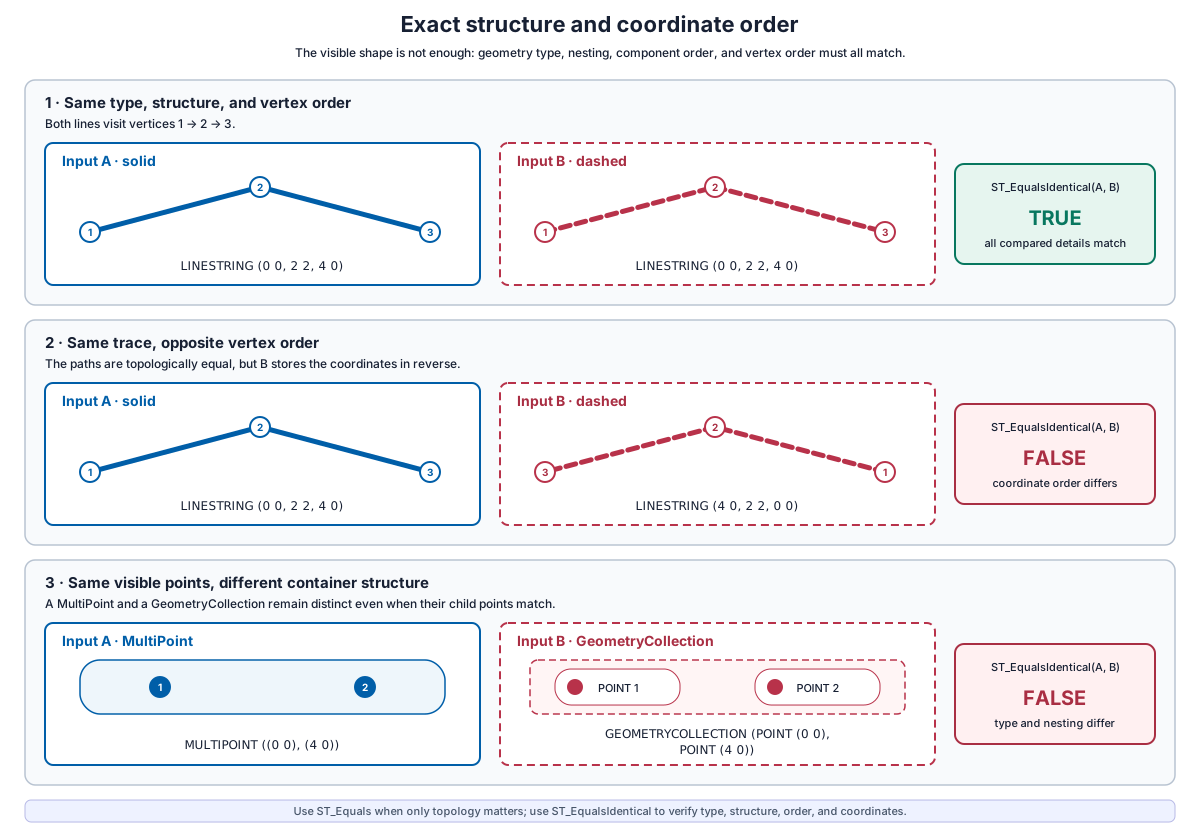
The inputs are shown separately so their traversal direction and container structure are easy to compare. Geometries can occupy the same locations and still be non-identical when their vertex order, geometry type, or nesting differs.
Z, M, and ZM dimensions
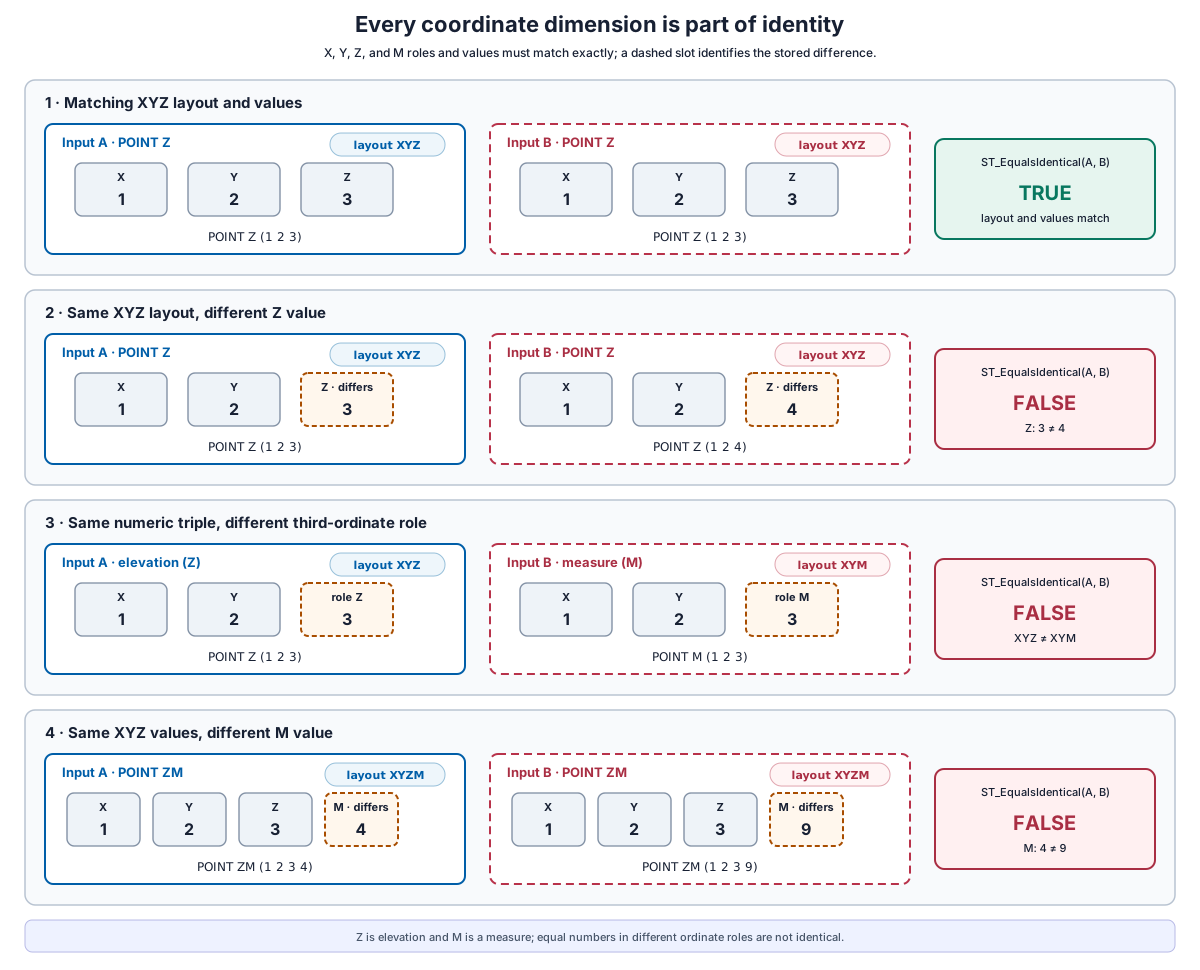
The coordinate layout is part of a geometry's identity. POINT Z (1 2 3) and
POINT M (1 2 3) contain the same numeric values, but the third ordinate has a different role.
For ZM geometries, both the Z and M values participate in the comparison.
Choosing an equality predicate
| Predicate | Comparison | Typical use |
|---|---|---|
ST_Equals |
Same two-dimensional topology; representation and ordering may differ | Find geometries that describe the same shape |
ST_EqualsExact |
Same structure and order, with corresponding X/Y coordinates within a tolerance; Z/M are ignored | Accept small X/Y representation differences |
ST_EqualsIdentical |
Same type, structure, order, dimensional layout, and exact X/Y/Z/M ordinate values | Verify that a geometry representation was preserved |
ST_EqualsIdentical does not compare SRID, precision model, user data, or the coordinate-sequence
implementation. Compare SRIDs separately when CRS identity is also required.
The predicate compares the dimensions retained by the geometry value it receives. At Spark and Flink serialization boundaries, JTS cannot distinguish ordinary XY coordinates from declared XYZ coordinates when every Z ordinate is NaN; those values may normalize to XY. Empty XYZ values and zero-member collections have the same limitation. Mixed layouts within a Polygon or multi-geometry are rejected by the serializer; use a GeometryCollection when members need independent layouts.
SQL examples
Identical XYZ geometries
Identical geometries return true:
SELECT ST_EqualsIdentical(
    ST_GeomFromWKT('POINT Z (1 2 3)'),
    ST_GeomFromWKT('POINT Z (1 2 3)')
)
Output:
true
Topological equality versus identity
These paths occupy the same locations, so ST_Equals returns true. Their coordinate sequences
run in opposite directions, so ST_EqualsIdentical returns false.
WITH paths AS (
    SELECT
        ST_GeomFromWKT('LINESTRING (0 0, 1 1, 2 0)') AS forward_path,
        ST_GeomFromWKT('LINESTRING (2 0, 1 1, 0 0)') AS reverse_path
)
SELECT
    ST_Equals(forward_path, reverse_path) AS same_shape,
    ST_EqualsIdentical(forward_path, reverse_path) AS identical
FROM paths;
Output:
same_shape | identical
-----------+----------
true       | false
Z, M, and ZM dimensions
Every ordinate value and its dimensional role must match:
SELECT
    ST_EqualsIdentical(
        ST_GeomFromWKT('POINT Z (1 2 3)'),
        ST_GeomFromWKT('POINT Z (1 2 4)')
    ) AS changed_z,
    ST_EqualsIdentical(
        ST_GeomFromWKT('POINT M (1 2 3)'),
        ST_GeomFromWKT('POINT M (1 2 4)')
    ) AS changed_m,
    ST_EqualsIdentical(
        ST_GeomFromWKT('POINT Z (1 2 3)'),
        ST_GeomFromWKT('POINT M (1 2 3)')
    ) AS z_is_not_m,
    ST_EqualsIdentical(
        ST_GeomFromWKT('POINT ZM (1 2 3 4)'),
        ST_GeomFromWKT('POINT ZM (1 2 3 4)')
    ) AS same_xyzm;
Output:
changed_z | changed_m | z_is_not_m | same_xyzm
----------+-----------+------------+----------
false     | false     | false      | true
Geometry structure and SRID
Geometry type and nesting are compared. SRID is intentionally ignored.
SELECT
    ST_EqualsIdentical(
        ST_GeomFromWKT('MULTIPOINT ((0 0))'),
        ST_GeomFromWKT('GEOMETRYCOLLECTION (POINT (0 0))')
    ) AS different_types,
    ST_EqualsIdentical(
        ST_SetSRID(ST_GeomFromWKT('POINT (1 2)'), 4326),
        ST_SetSRID(ST_GeomFromWKT('POINT (1 2)'), 3857)
    ) AS srid_is_ignored;
Output:
different_types | srid_is_ignored
----------------+----------------
false           | true
Identity does not imply CRS compatibility. Validate or transform SRIDs before using the geometries together.
NaN and NULL
NaN ordinates compare equal to NaN ordinates in the corresponding position. A SQL NULL operand produces NULL.
SELECT
    ST_EqualsIdentical(
        ST_GeomFromWKT('POINT (NaN 2)'),
        ST_GeomFromWKT('POINT (NaN 2)')
    ) AS matching_nan,
    ST_EqualsIdentical(
        NULL,
        ST_GeomFromWKT('POINT (1 2)')
    ) AS null_result;
Output:
matching_nan | null_result
-------------+------------
true         | NULL
Practical use: geometry round-trip validation
Use ST_EqualsIdentical for deterministic change detection after serialization, storage, or an
ETL rewrite. It can reveal a reversed coordinate sequence, a changed geometry container, or a
lost Z/M ordinate even when ST_Equals reports the same shape.
The following query flags rows whose geometry representation changed:
SELECT
    record_id,
    CASE
        WHEN source_geometry IS NULL OR reloaded_geometry IS NULL THEN 'missing_geometry'
        WHEN ST_EqualsIdentical(source_geometry, reloaded_geometry) THEN 'unchanged'
        ELSE 'changed'
    END AS validation_result
FROM geometry_round_trip;
This predicate checks geometric content, not a byte-for-byte encoding. Compare SRID and any
application metadata separately when those fields are part of the validation contract. Where the
input geometry types support topological equality, use ST_Equals in a separate comparison to
distinguish representation-only changes from changed topology.