ST_SharedPaths
Introduction: Returns the paths shared by two lineal geometries, grouped by traversal direction.
Format: ST_SharedPaths(A: geometry, B: geometry)
Return type: Geometry
This function supports Snowflake GEOMETRY values. It is not available for GEOGRAPHY values.
Both inputs must be a LineString or MultiLineString. The result is a GeometryCollection
containing exactly two MultiLineString elements. The first contains paths traversed in the same
direction by both inputs; the second contains paths traversed in opposite directions. Coordinates
in both elements follow the direction of A.
Use ST_GeometryN(result, 1) to access the first element and ST_GeometryN(result, 2) to
access the second.
For non-simple inputs that traverse the same path more than once, direction follows the first
matching source traversal. Consequently, swapping A and B can change which result element
contains a path.
Snowflake's native GEOMETRY bridge passes values to Sedona as GeoJSON, which does not carry SRID
metadata. Consequently, this variant cannot reject mixed input SRIDs or preserve a matching SRID;
its result has SRID 0. The legacy binary geometry interface preserves matching SRIDs. A non-empty
result retains Z only when at least one input has Z and every coordinate of every returned shared
path resolves to a finite Z from the input geometries. If any returned coordinate does not resolve
to a finite source Z, the entire result is two-dimensional. M values are always dropped. A result
with no shared paths is also two-dimensional.
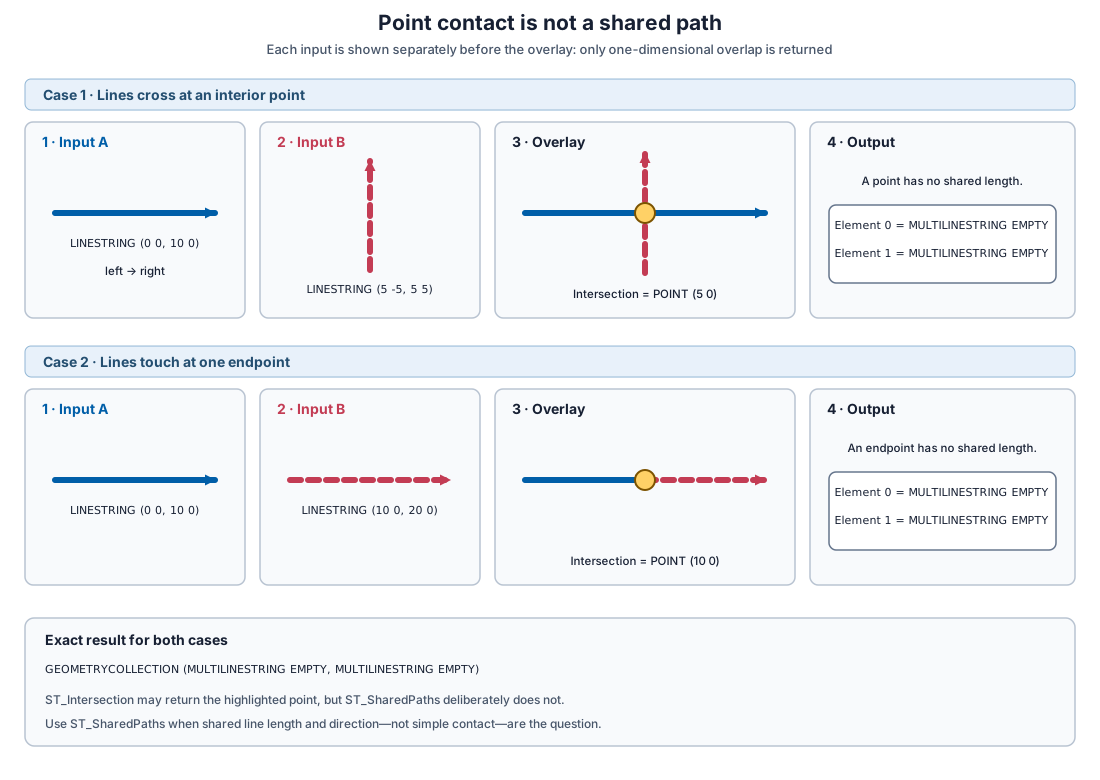
When the inputs do not share a path, including when they intersect only at points, both elements
are empty MultiLineString geometries.
Visual examples
Same and opposite directions
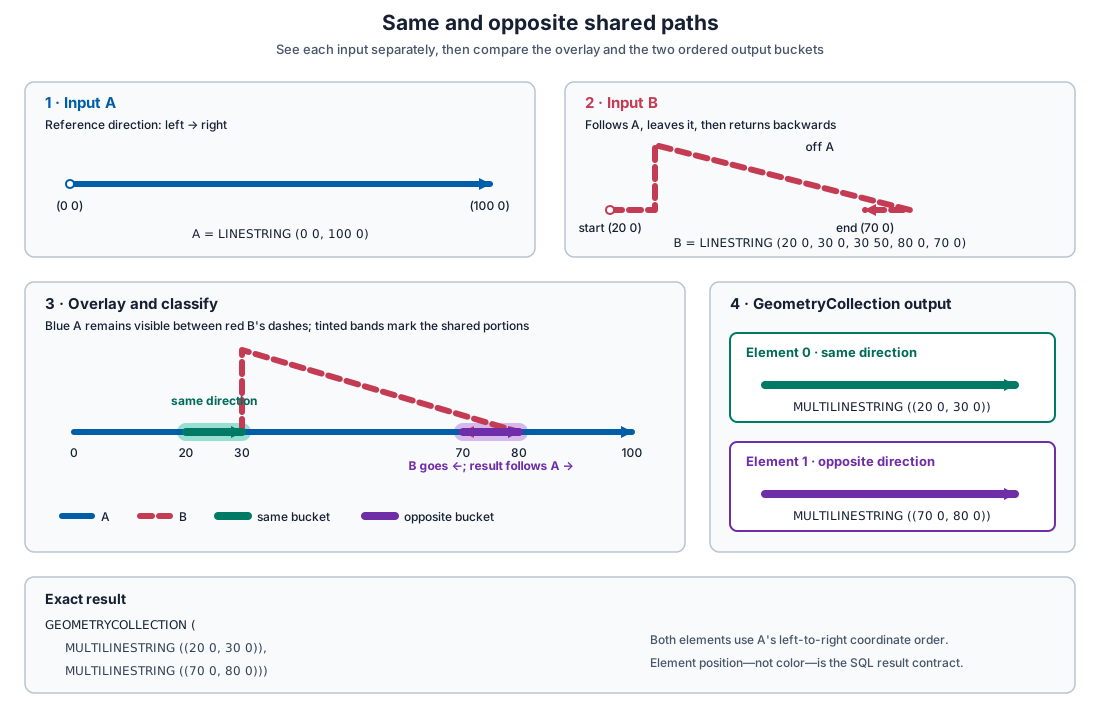
Input B first follows A, leaves it, and later traverses another part of A backwards. The
single result therefore populates both direction buckets. Notice that the path in the second
element is reoriented to follow A, even though B traverses it in the opposite direction.
Multipart input and noded output
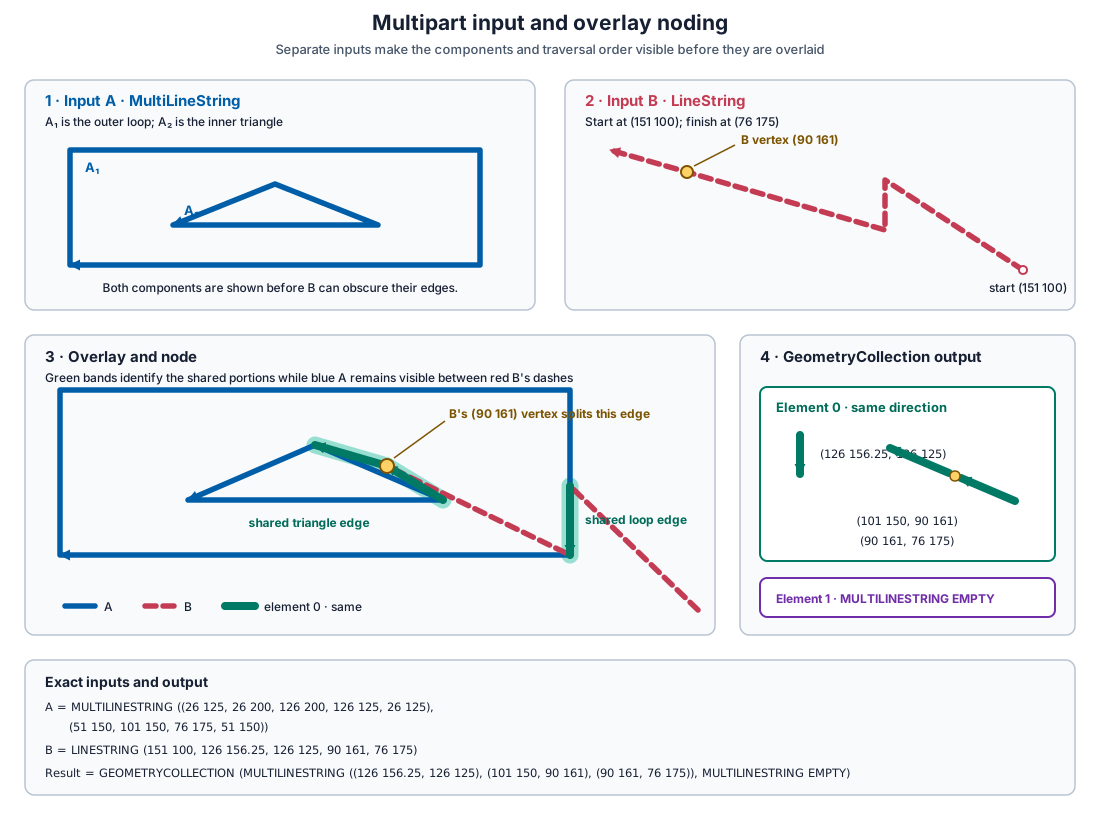
Input A can be a MultiLineString. In this example, B shares part of two different components
of A. The vertex at (90 161) belongs to B and splits the shared diagonal into two paths in
the first element.
Point-only intersections
Crossing at an interior point and touching at an endpoint are both zero-dimensional contacts.
Neither is a shared path, so both MultiLineString elements are empty.
SQL examples
Wrap the result in ST_AsText to display its two direction buckets as WKT.
Same direction
The shared interval is returned in the first element because both inputs traverse it from left to right.
SELECT ST_AsText(ST_SharedPaths(
    ST_GeometryFromWKT('LINESTRING (0 0, 10 0)'),
    ST_GeometryFromWKT('LINESTRING (5 0, 15 0)')
));
Output:
GEOMETRYCOLLECTION (MULTILINESTRING ((5 0, 10 0)), MULTILINESTRING EMPTY)
Opposite direction
The shared interval is returned in the second element because B traverses it from right to
left. Its coordinates still follow the left-to-right direction of A.
SELECT ST_AsText(ST_SharedPaths(
    ST_GeometryFromWKT('LINESTRING (0 0, 10 0)'),
    ST_GeometryFromWKT('LINESTRING (15 0, 5 0)')
));
Output:
GEOMETRYCOLLECTION (MULTILINESTRING EMPTY, MULTILINESTRING ((5 0, 10 0)))
Same and opposite paths in one result
One input pair can populate both elements. Here, B first follows A, leaves it, and later
returns along A in the opposite direction.
SELECT ST_AsText(ST_SharedPaths(
    ST_GeometryFromWKT('LINESTRING (0 0, 100 0)'),
    ST_GeometryFromWKT('LINESTRING (20 0, 30 0, 30 50, 80 0, 70 0)')
));
Output:
GEOMETRYCOLLECTION (MULTILINESTRING ((20 0, 30 0)), MULTILINESTRING ((70 0, 80 0)))
Multipart input and noded output
Shared paths can come from different components of a MultiLineString. The overlay is noded at
vertices from either input, so a shared path may be shorter than its containing input segment.
SELECT ST_AsText(ST_SharedPaths(
    ST_GeometryFromWKT(
        'MULTILINESTRING ((1 3, 4 2, 7 2, 7 5), (13 10, 14 7, 11 6, 15 5))'
    ),
    ST_GeometryFromWKT(
        'LINESTRING (2 1, 4 2, 7 2, 8 3, 10 6, 11 6, 14 7, 16 9)'
    )
));
Output:
GEOMETRYCOLLECTION (MULTILINESTRING ((4 2, 7 2)), MULTILINESTRING ((14 7, 11 6)))
No lineal overlap
Lines that cross only at a point do not share a path, so both elements are empty.
SELECT ST_AsText(ST_SharedPaths(
    ST_GeometryFromWKT('LINESTRING (0 0, 10 0)'),
    ST_GeometryFromWKT('LINESTRING (5 -5, 5 5)')
));
Output:
GEOMETRYCOLLECTION (MULTILINESTRING EMPTY, MULTILINESTRING EMPTY)
Practical use: comparing linear networks
ST_SharedPaths is useful when two road, rail, pipeline, or utility-network datasets contain
coincident centerlines and direction matters. For example, it can distinguish a road segment
digitized consistently in two datasets from a one-way segment digitized in reverse. It can also
measure how much of an inspected utility route follows its reference alignment in either
direction.
The following query assumes that a spatial join has already paired candidate segments. The first element measures consistently directed overlap, while the second element measures reversed overlap:
WITH compared AS (
    SELECT
        segment_id,
        ST_SharedPaths(reference_geom, candidate_geom) AS shared
    FROM network_segment_pairs
)
SELECT
    segment_id,
    ST_Length(ST_GeometryN(shared, 1)) AS same_direction_length,
    ST_Length(ST_GeometryN(shared, 2)) AS opposite_direction_length
FROM compared;
Rows with a positive opposite_direction_length are useful candidates for direction or one-way
attribute review. Apply ST_SharedPaths after candidate matching rather than to every possible
pair in two large networks. The function finds exact lineal overlap; snap or otherwise normalize
nearly coincident datasets first when their coordinates differ within an accepted tolerance.