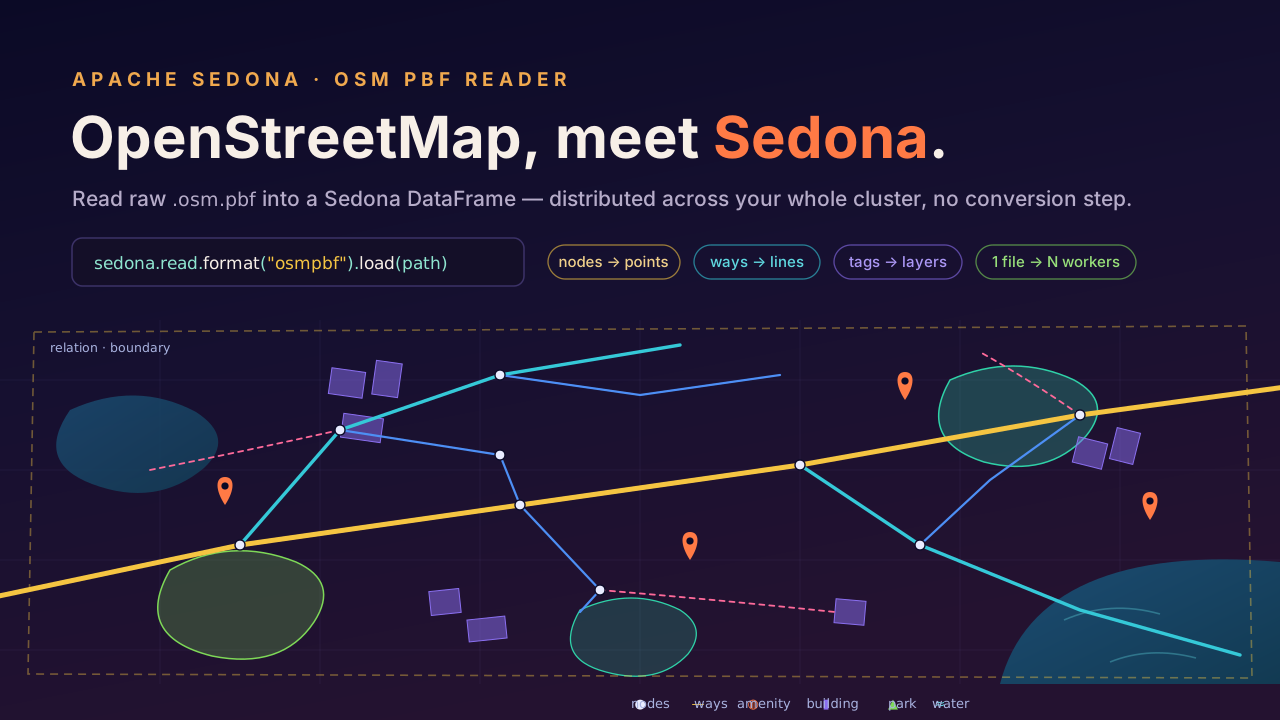
OpenStreetMap is the world's map — every road, café, and coastline, edited by millions of people. It ships as .osm.pbf: a dense, compressed Protocol-Buffers blob of nodes, ways, and relations. Getting that into a cluster usually means a preprocessing detour through osmium or a staging database.
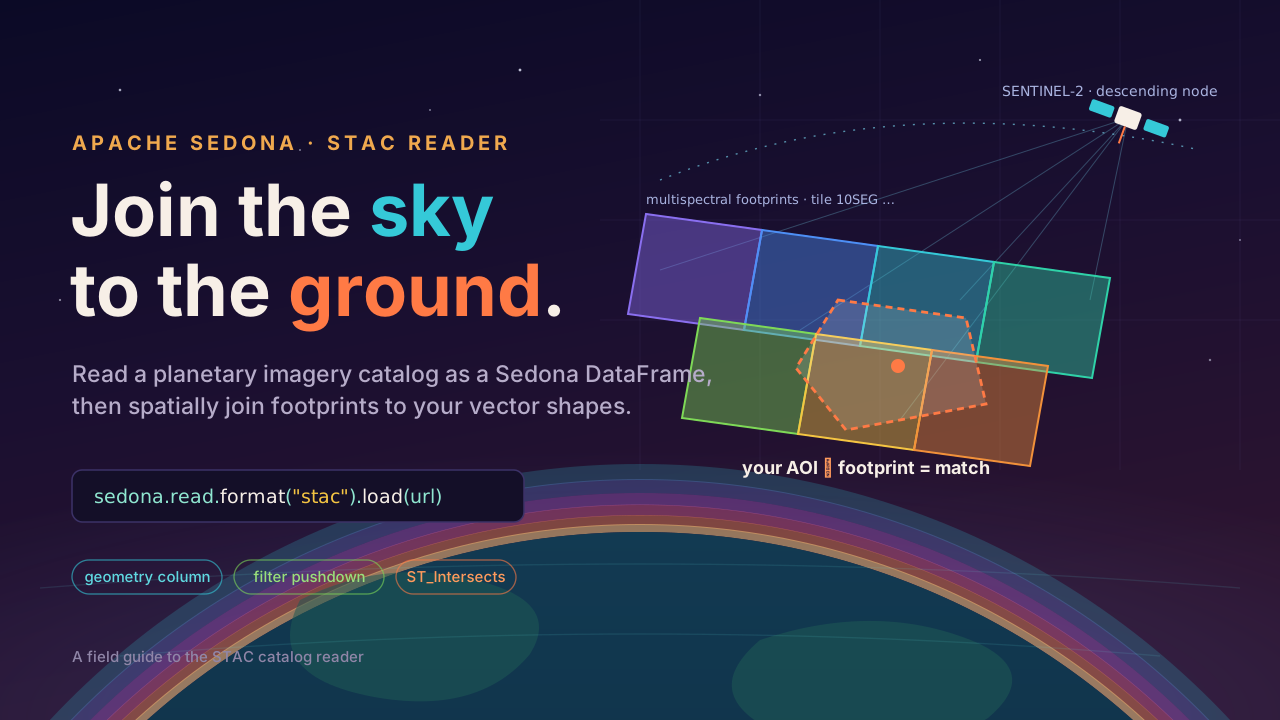
You have the shapes. Somewhere in a petabyte of satellite imagery are exactly the scenes that cover them. The hard part was never the analysis — it was the plumbing in between.
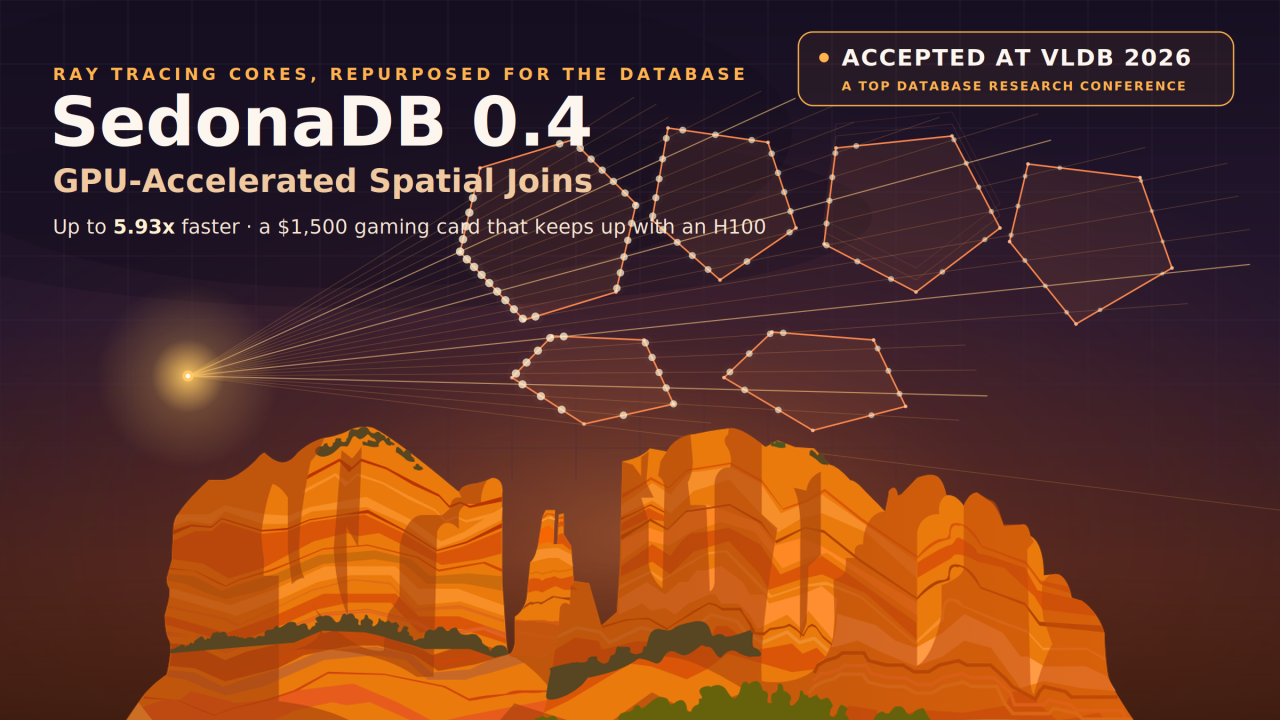
The Apache Sedona community is excited to announce the release of SedonaDB version 0.4.0!
SedonaDB is the first open-source, single-node analytical database engine that treats spatial data as a first-class citizen. It is developed as a subproject of Apache Sedona. This release consists of 187 resolved issues including 26 new functions from 15 contributors.
Apache Sedona powers large-scale geospatial processing on distributed engines like Spark (SedonaSpark), Flink (SedonaFlink), and Snowflake (SedonaSnow). SedonaDB extends the Sedona ecosystem with a single-node engine optimized for small-to-medium data analytics, delivering the simplicity and speed that distributed systems often cannot.
The Apache Sedona community is excited to announce the release of
SedonaDB version 0.3.0!
SedonaDB is the first open-source, single-node analytical database
engine that treats spatial data as a first-class citizen. It is
developed as a subproject of Apache Sedona. This release consists of
187 resolved
issues
including 36 new functions from 18 contributors.
Apache Sedona powers large-scale geospatial processing on distributed
engines like Spark (SedonaSpark), Flink (SedonaFlink), and Snowflake
(SedonaSnow). SedonaDB extends the Sedona ecosystem with a single-node
engine optimized for small-to-medium data analytics, delivering the
simplicity and speed that distributed systems often cannot.
2025 was a milestone year for Apache Sedona. We made major progress in distributed spatial analytics on Spark, Flink, and Snowflake, launched a new single-node engine called SedonaDB, and pushed forward benchmarking and open geospatial data standards.
This post summarizes the most important highlights from the Apache Sedona ecosystem in 2025.
Recently Databricks announced that Serverless SQL users "will see up to 17x faster performance compared to classic clusters with Apache Sedona installed." Unfortunately, Databricks didn’t speak to the cost of the results. It is also an apples-to-oranges comparison because the serverless compute shape and quantity that Databricks deployed to generate the 17x performance difference was not shared. Their result was also limited to specific query configurations.
We saw an opportunity to address these issues using SpatialBench, a new benchmarking framework for spatial queries. Because we are comparing different infrastructure types, our benchmark normalizes on price-performance rather than performance alone, while providing what we believe is a more comprehensive benchmarking result.
We found that only one of the simpler SpatialBench queries (#2) tested on Databricks SQL Serverless had price-performance aligned with the Databricks claim. However, we found that Sedona excelled in most other queries, delivering up to 6x better price-performance, while offering more query coverage.
SpatialBench is a benchmarking framework for spatial joins, distance queries, and point-in-polygon analyses.
Traditional benchmarking frameworks don’t include spatial workflows. It’s important to benchmark spatial workflows separately because an engine that’s fast for tabular data analyses isn’t necessarily performant for spatial queries.
For example, here are the SpatialBench results for Scale Factor 1 (SF-1) and SF-10 for SedonaDB, DuckDB, and GeoPandas on a single ec2 instance:
The Apache Sedona community is excited to announce the release of SedonaDB version 0.2.0!
SedonaDB is the first open-source, single-node analytical database engine that treats spatial data as a first-class citizen. It is developed as a subproject of Apache Sedona. This release consists of 136 resolved issues including 40 new functions from 17 contributors.
Apache Sedona powers large-scale geospatial processing on distributed engines like Spark (SedonaSpark), Flink (SedonaFlink), and Snowflake (SedonaSnow). SedonaDB extends the Sedona ecosystem with a single-node engine optimized for small-to-medium data analytics, delivering the simplicity and speed that distributed systems often cannot.